A founder I know sent 5,000 cold emails last quarter.
He got four replies.
Three were "unsubscribe." One was a guy asking why he got added to a "newsletter" he never signed up for.
So the founder did what most founders do after a campaign like that. He posted on LinkedIn: "Cold email is dead. Don't waste your time."
Forty people liked it. Twenty agreed in the comments. A few shared their own horror stories.
Nobody asked the obvious question.
Was cold email actually dead? Or was his strategy dead, and cold email just happened to be standing next to the body?
That distinction matters more than almost anything else in outbound right now, because the companies booking 20, 30, 50 meetings a month from cold email aren't doing anything mystical. They're not sitting on some secret template nobody else has seen. They're just not making the five or six mistakes that killed that founder's campaign.
This isn't an article defending cold email out of nostalgia. I've run outbound at scale, watched campaigns succeed and completely flop, and seen the exact moment where "this isn't working" becomes "this channel is dead" in someone's head. That moment is almost always wrong.
So let's actually look at what's happening.
Is Cold Email Dead?
No.
Cold email is not dead.
Generic, mass-sent outreach is.
Businesses that target the right audience, personalize their messaging, maintain strong email deliverability, and follow up consistently continue to book meetings through cold email in 2026. The channel still works, the approach has changed.
📖 In This Guide
→ Why Everyone Thinks Cold Email Is Dead
→ The Real Problem Isn't Cold Email
→ What Actually Changed Between 2020 and 2026
→ The Psychology Behind Replies
→ The Biggest Cold Email Mistakes
→ What Winning Outbound Teams Do Differently
→ How AI Changed Cold Email
→ How Autoworkx Fits Into Modern Outbound
→ The Future of Cold Email
→ Frequently Asked Questions
Why Everyone Thinks Cold Email Is Dead
Open your own inbox right now. Scroll through the last twenty unread emails from companies you've never heard of.
Notice the pattern.
"Hi {firstName}, I noticed you're the {jobTitle} at {company} and wanted to reach out because..."
You've seen this email a thousand times with different names plugged in. So has everyone else. That's the first reason people think cold email is dead: most of it is the same email, copy-pasted across an entire industry, with a merge field doing the heavy lifting instead of actual thought.
Then there's the volume problem. Tools made sending easy. Too easy. A founder can now blast 10,000 emails in an afternoon without writing a single one personally. The barrier to entry dropped to almost nothing, so the inbox got flooded with low-effort outreach from people who never had a real list, a real offer, or a real reason to write to that specific person.
Add AI-powered personalization into the mix and it got worse before it got better. Early AI-generated cold emails were obvious. Overly polished. Strange phrasing that sounded like it was translated from corporate-speak into corporate-speak. Spam filters started catching on faster than senders adapted.
Then there's the domain problem nobody talks about enough. People buy a domain, set up an inbox, and start blasting cold emails on day one with zero warmup. The domain gets flagged within a week. Reply rates crash. The sender assumes it's the offer, the copy, or the channel. It's actually their own infrastructure that torched the campaign before a single prospect even saw the email.
Bad targeting closes the loop. Someone scrapes a list of "B2B SaaS founders," ignores firmographic fit completely, and emails everyone from a two-person bootstrapped startup to a 500-person enterprise with the same pitch. Of course the reply rate is near zero. The list was never built around a real buyer profile in the first place.
Put all of that together: generic templates, reckless volume, robotic AI content, burned domains, sloppy targeting. Run a campaign with even two of these problems and you'll get a result bad enough to convince yourself the entire channel is broken.
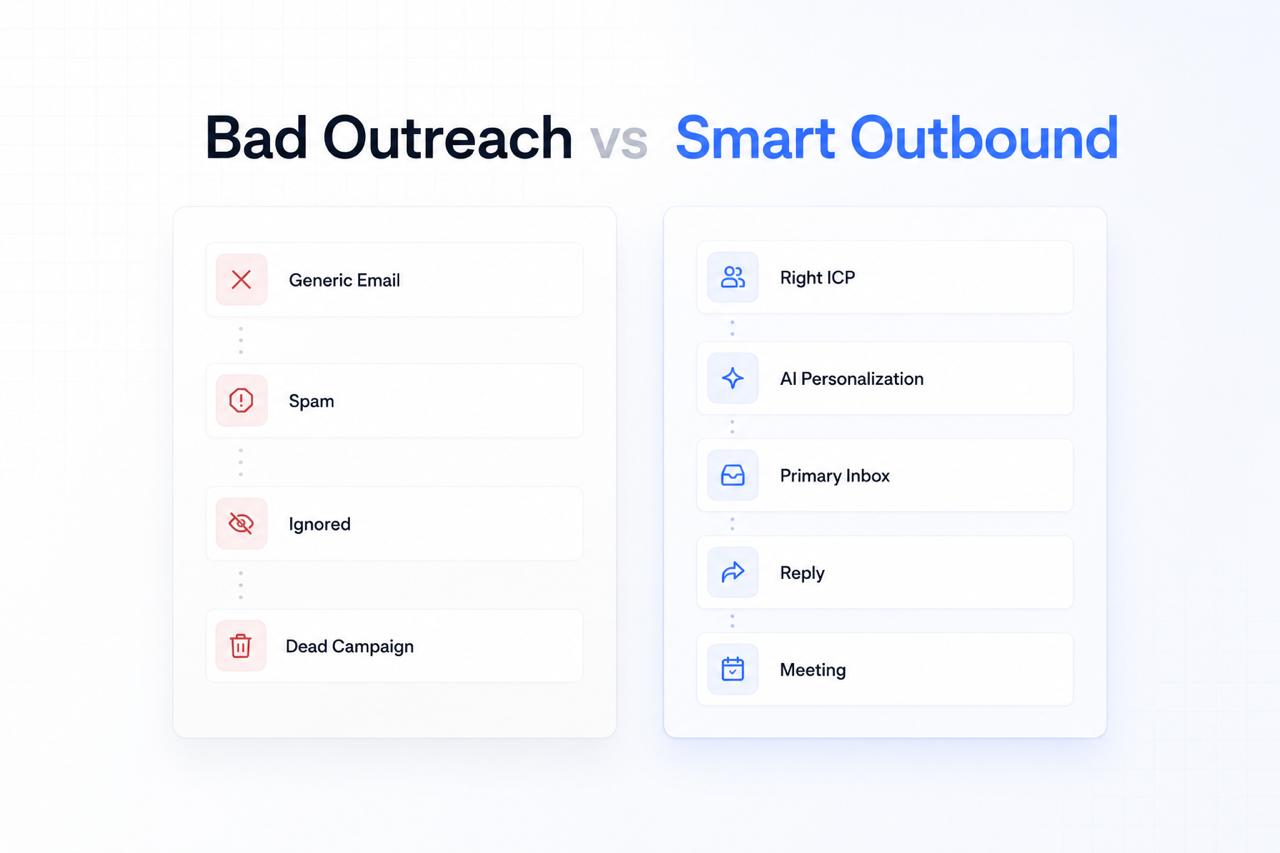
It isn't the channel. That's where everything breaks.
The Real Problem Isn't Cold Email
Here's the part most people skip past too quickly to actually sit with.
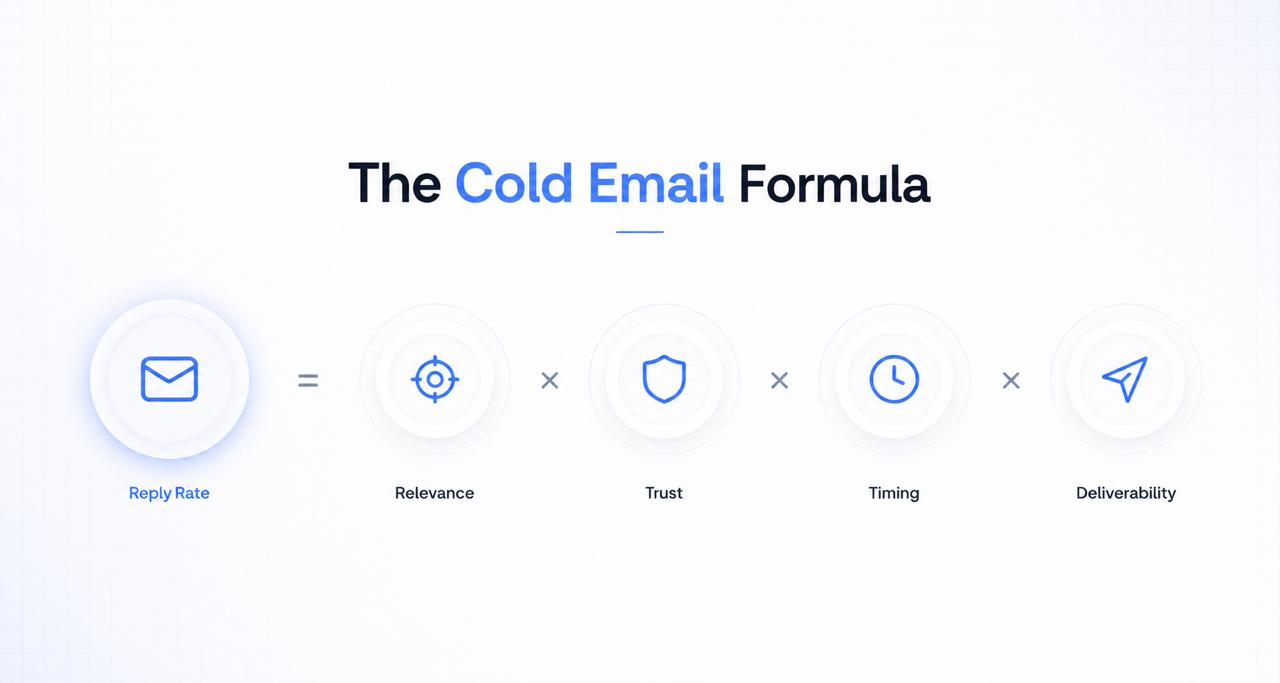
Cold email reply rates aren't determined by the channel. They're determined by relevance, multiplied by trust, multiplied by timing. If any one of those is close to zero, the whole equation collapses, no matter how good your subject line is.
Think about the actual mechanics. A cold email succeeds when a stranger, who has no obligation to read your message, decides in about three seconds that it's worth their attention. That's the entire game. Not "is cold email a good channel," but "did this specific message earn three seconds of attention from this specific person."
Most failed campaigns fail one of these checks, often more than one:
Bad lists. The email goes to people who were never going to care, regardless of how the message was written. A perfectly written email to the wrong person still gets ignored.
Bad offers. The pitch doesn't solve a problem the recipient currently feels. You can write the most compelling email in the world about a product nobody in that segment needs right now, and it will still fail.
Bad timing. The recipient just signed a contract with a competitor, just got laid off, just got promoted and is buried in onboarding. Timing isn't something most senders even think about, yet it quietly kills more replies than bad copy does.
Bad copy. Long paragraphs about the sender's company. Buzzword-heavy claims. No clear point. This is the one people obsess over the most, and it's usually not even the biggest problem.
Bad deliverability. The email never reaches the inbox. It lands in spam, or worse, gets filtered before delivery entirely. No amount of personalization fixes a message that never gets seen.
Lack of relevance. The email could have been sent to literally anyone in the same job title at any company. There's nothing in it that proves the sender actually looked at this person's specific situation.
Notice something about that list. Only one item, copy, is actually about writing. The other five are strategic, technical, or research problems disguised as writing problems.
This is why "just write better cold emails" advice fixes almost nothing for most teams. They don't have a copy problem. They have a strategy problem wearing a copy costume.
What Actually Changed Between 2020 and 2026
People who say "cold email used to work" aren't wrong. It did work differently a few years ago, and pretending nothing changed would be dishonest.
In 2020, a decent personalized email with a clear offer could get a 10 to 15 percent reply rate without much effort, simply because inboxes were less crowded and expectations were lower. Buyers hadn't yet been trained to distrust outreach.
By 2026, the average professional inbox is buried. Every SaaS company, every agency, every consultant figured out cold outreach at roughly the same time, and they all started sending. The result is a buyer who has seen thousands of "quick question" subject lines and developed an immune response to anything that smells templated.
Spam filters evolved alongside this. Gmail and Outlook got dramatically better at detecting bulk sending patterns, identical phrasing across multiple sends, and suspicious link structures. What got through easily in 2020 gets quarantined automatically now. Deliverability isn't a "nice to have" skill anymore. It's the floor you need to clear before anything else matters.
AI changed content creation in a way that cuts both directions. On one hand, it became trivially easy to generate outreach at scale, which is exactly why inboxes got flooded with mediocre AI copy. On the other hand, AI also made real, specific personalization possible at a scale that used to require an army of SDRs doing manual research. The tool that flooded inboxes with garbage is the same tool that, used properly, makes genuinely relevant outreach possible for a two-person team.
Buyer expectations rose because buyers got savvier. They've seen the playbooks. They know what a templated email looks like, what a fake compliment sounds like, what a forced "I noticed you just raised your Series A" opener feels like when it's clearly automated. The bar for what counts as "actually relevant" moved up significantly.
And trust matters more than it ever did, because attention is the scarcest resource in B2B right now. A buyer doesn't need to find a solution. Solutions find them constantly. What they're actually filtering for is who's worth trusting enough to give fifteen minutes to.
None of this means cold email got worse as a channel. It means the channel got more honest. It stopped rewarding effortless volume and started rewarding actual thought. That's a harder game, but it's also a fairer one, because it means the senders who put in real work finally have a real advantage instead of getting drowned out by sheer email volume from people who didn't.
The Psychology Behind Replies
Strip away the templates and the tools for a second. A reply is a human decision, and humans reply for very specific psychological reasons.
Relevance comes first. Not "this could theoretically apply to my industry" relevance, but "this person clearly looked at something specific about my situation" relevance. The brain processes irrelevant messages as noise almost instantly. It barely registers them as worth a response.
Timing is underrated because it's invisible from the sender's side. You don't know that the VP of Sales you're emailing just got handed a mandate to fix exactly the problem you're solving. You don't know they don't care at all because they just renewed with a competitor. Timing isn't something you can fully control, but you can stack the odds by targeting trigger events: funding rounds, leadership changes, product launches, hiring spikes in a relevant department.
Curiosity drives opens and, sometimes, replies. A subject line that creates a small information gap (without being a manipulative clickbait trick) makes someone want to know what's on the other side. "Question about your outbound process" creates curiosity. "Revolutionary AI solution for your sales team" creates an immediate mental "delete" reflex.
Credibility is the silent filter running in the background of every read. Does this sender sound like they know what they're talking about, or does this sound like a script someone else wrote for them? Specific numbers, specific observations, and a tone that sounds like an actual person all build credibility in seconds. Vague claims about being "the leading solution" destroy it just as fast.
Perceived effort might be the most overlooked factor of all. People can sense, almost instinctively, whether an email took thirty seconds to generate or five minutes to think through. That perception changes how the message gets read entirely. An email that feels effortful earns reciprocal effort. An email that feels like spam earns the delete key.
This is why pure copywriting tricks, the kind that work in cold consumer marketing, often backfire in B2B cold email. A buyer who feels manipulated doesn't just ignore the email. They remember the company name and avoid it later.
There's a quieter factor too, one that rarely gets discussed: status. A reply, even a polite "not right now," costs the recipient something. It signals that they took your message seriously enough to engage. Most strangers don't want to spend that social capital on something that looks low-effort, because replying to a lazy email and getting ignored or pitched harder afterward feels like a worse outcome than just deleting it. The senders who get replies consistently are the ones who make responding feel safe and low-cost, not like the first step into a pushy sales process.
This also explains why a soft, specific question often outperforms a hard pitch in a first cold email. "Worth a quick chat?" forces a bigger decision than "Curious how you're currently handling X." The second one lowers the bar for a reply because it doesn't ask the recipient to commit to anything yet. It just asks them to share information they probably already have an opinion on.
The Biggest Cold Email Mistakes
Some of these will feel obvious. They keep happening anyway, which is exactly why they're worth listing plainly.
Sending before warming domains. A brand new domain sending cold email immediately gets treated as suspicious by mail servers. Warmup isn't optional anymore. It's table stakes.
No real ICP. "B2B companies" is not an ideal customer profile. Without a tight definition of who actually buys, gets value fast, and is reachable through email, every list becomes a guessing game.
Writing about yourself. "We are a leading provider of..." Nobody cares. The first line of a cold email should be about the recipient's world, not the sender's company history.
Weak subject lines. Either too salesy ("Boost your revenue by 300%!") or too vague to create any curiosity at all. Both get ignored at the same rate.
Generic personalization. Inserting a first name and company name isn't personalization. It's a mail merge wearing a costume. Real personalization references something specific the recipient would recognize as true about their own situation.
Sending too many emails too fast. Aggressive volume without proper inbox rotation and sending limits is one of the fastest ways to get domains flagged and burned.
Stopping after one follow-up. Most replies come from follow-up two, three, or four, not the first email. Giving up early throws away the majority of potential replies.
Optimizing for opens instead of meetings. Open rates feel good to look at. They don't pay the bills. A campaign with a 60 percent open rate and zero meetings booked is still a failed campaign.
A quick gut-check checklist before launching any campaign:
Is the list built around a specific, narrow ICP, not a broad category?
Has the sending domain been warmed for at least two to three weeks?
Does the first line reference something true and specific about the recipient?
Is the offer something this exact segment is likely to feel right now?
Is there a follow-up sequence of at least four touches?
Is success measured by replies and meetings, not opens?
If any answer is no, fix that before sending a single email.
What Winning Outbound Teams Do Differently
The gap between teams that struggle with cold email and teams that consistently book meetings isn't talent. It's process discipline.
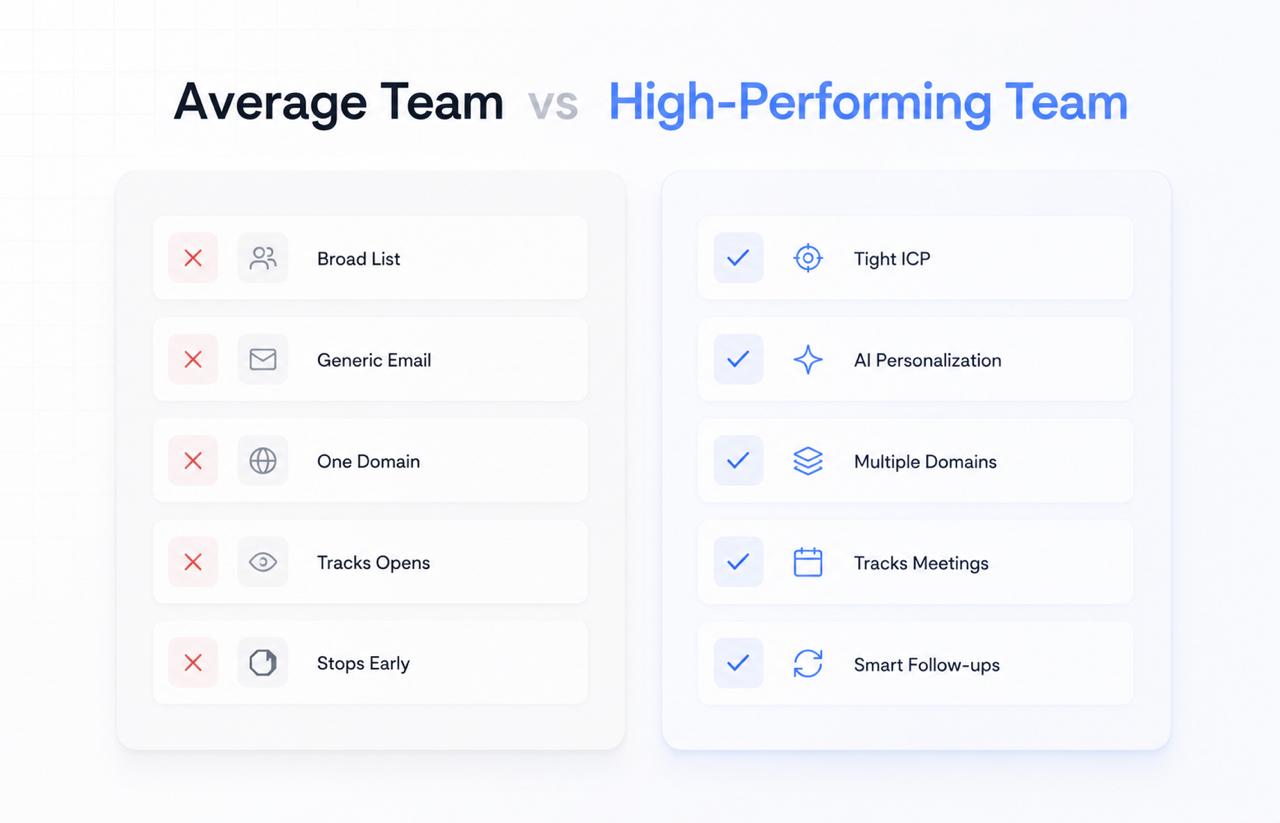
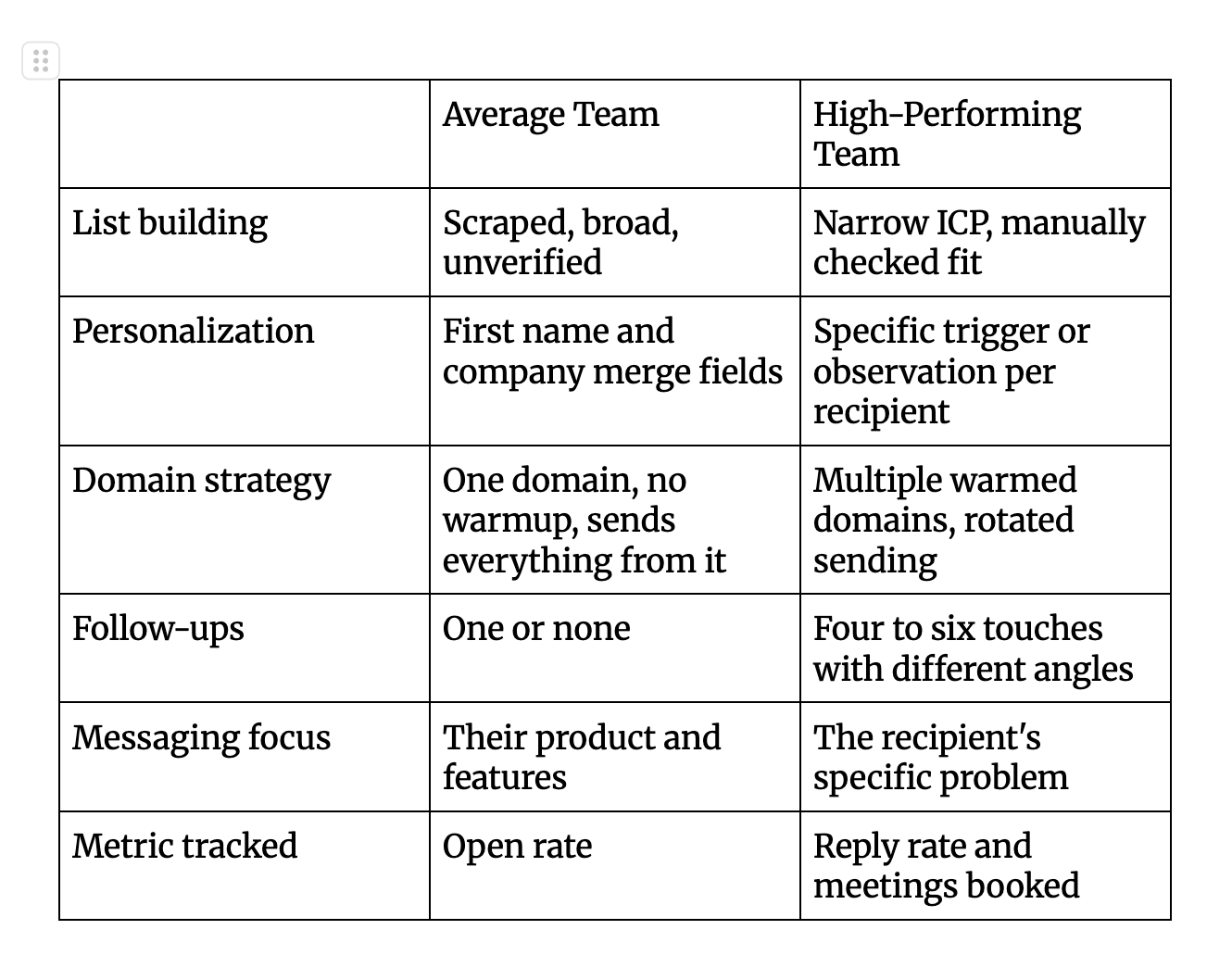
What stands out when you look at this side by side is that none of it requires a massive team or budget. It requires discipline and a willingness to actually look at what the data says instead of assuming the channel itself is the variable.
High-performing teams also treat cold email as a system, not a one-off campaign. They track reply rate by segment, by subject line, by opening line structure. They notice that Tuesday and Thursday sends outperform Monday. They notice that emails under 80 words outperform longer ones for cold (not warm) outreach. They adjust weekly instead of running the same dead sequence for three months and then declaring the channel broken.
One habit separates the best teams from everyone else more than any single tactic: they review actual replies, not just dashboard numbers, every week. Reading the real responses, the "not interested," the "send more info," the silence after an interested reply, surfaces patterns no metric captures on its own. A team that notices three prospects in a row mentioning the same competitor, or the same internal blocker, can adjust the offer or the messaging before the next hundred emails go out instead of after.
The other quiet advantage high-performing teams have is patience paired with measurement. They don't expect a brand new list or a brand new domain to perform on day one. They give a sequence enough volume to be statistically meaningful before deciding whether it works, then kill it fast once it's clear it doesn't. Most underperforming teams do the opposite: they panic after fifty sends, abandon a perfectly reasonable approach too early, then stick with a genuinely bad one for months because nobody set a clear bar for when to cut it.
How AI Changed Cold Email
This is where it gets honest, because AI gets blamed for killing cold email and credited with saving it, often in the same week.
Both things are partially true.
AI made it absurdly easy to generate low effort outreach at scale. Anyone can now produce a thousand "personalized" emails in minutes with a basic prompt, and a meaningful chunk of the inbox flood happening right now is exactly that. AI didn't kill cold email. It exposed how much of cold email was already lazy, then made the laziness scalable.
But that's only half the story, and it's the half that gets the most attention because it's the easy headline.
The other half is where AI is genuinely changing what's possible. Research that used to take an SDR ten minutes per prospect (checking LinkedIn, the company website, recent news, job postings) can now happen in seconds, pulled together into something an actual person can use to write a genuinely relevant first line. Personalization that used to mean a first name and company name can now reference a specific detail because AI did the digging a human didn't have time to do at scale.
Follow-up sequencing got smarter too. AI can track reply sentiment and route a "not interested" response differently than a "maybe later" response, instead of every reply ending up in the same generic follow-up bucket. Lead scoring improved because AI can weigh dozens of signals (firmographic fit, engagement behavior, intent data) faster than a person manually scoring a spreadsheet ever could.
The honest takeaway: AI didn't replace good outbound thinking. It removed the excuse for not doing it. Teams that use AI to actually research and personalize are pulling further ahead of teams using AI to generate more volume of the same generic message. The gap between those two approaches is wider now than it's ever been, which is exactly why some companies are seeing record reply rates while others are watching theirs collapse, using the same underlying technology.
How Autoworkx Fits Into Modern Outbound
Most of the problems covered above (research that takes too long, personalization that doesn't scale, deliverability that quietly tanks campaigns, follow-ups that get forgotten) are exactly what eats up time for a small founder-led team or a lean sales org without a dozen SDRs to throw at the problem.
That's the gap Autoworkx was built around. Instead of personalization based on inserting a name into a template, it works off actual reply patterns and prospect signals to write outreach that doesn't read like it was mail-merged. Inbox rotation and domain health monitoring handle the deliverability side that quietly kills so many otherwise well-written campaigns. Follow-ups go out automatically based on what the previous message actually needs, not a rigid one-size sequence.
None of this replaces strategy. A platform can't fix a bad ICP or a weak offer. What it can do is remove the operational weight of doing the research, the warmup, and the follow-up discipline manually, so a founder or small team can focus on getting the strategy right instead of getting buried in execution.
If outbound is becoming an "operating system" problem (email, LinkedIn, lead enrichment, CRM sync, all needing to work together instead of as five disconnected tools) then the platforms that survive the next few years will be the ones built around that system, not just one channel in isolation.
The Future of Cold Email
AI-Powered Outbound
Ready to Book More Meetings?
Stop relying on generic outreach. Automate AI-powered personalization, follow-ups, deliverability, and lead engagement from one platform.
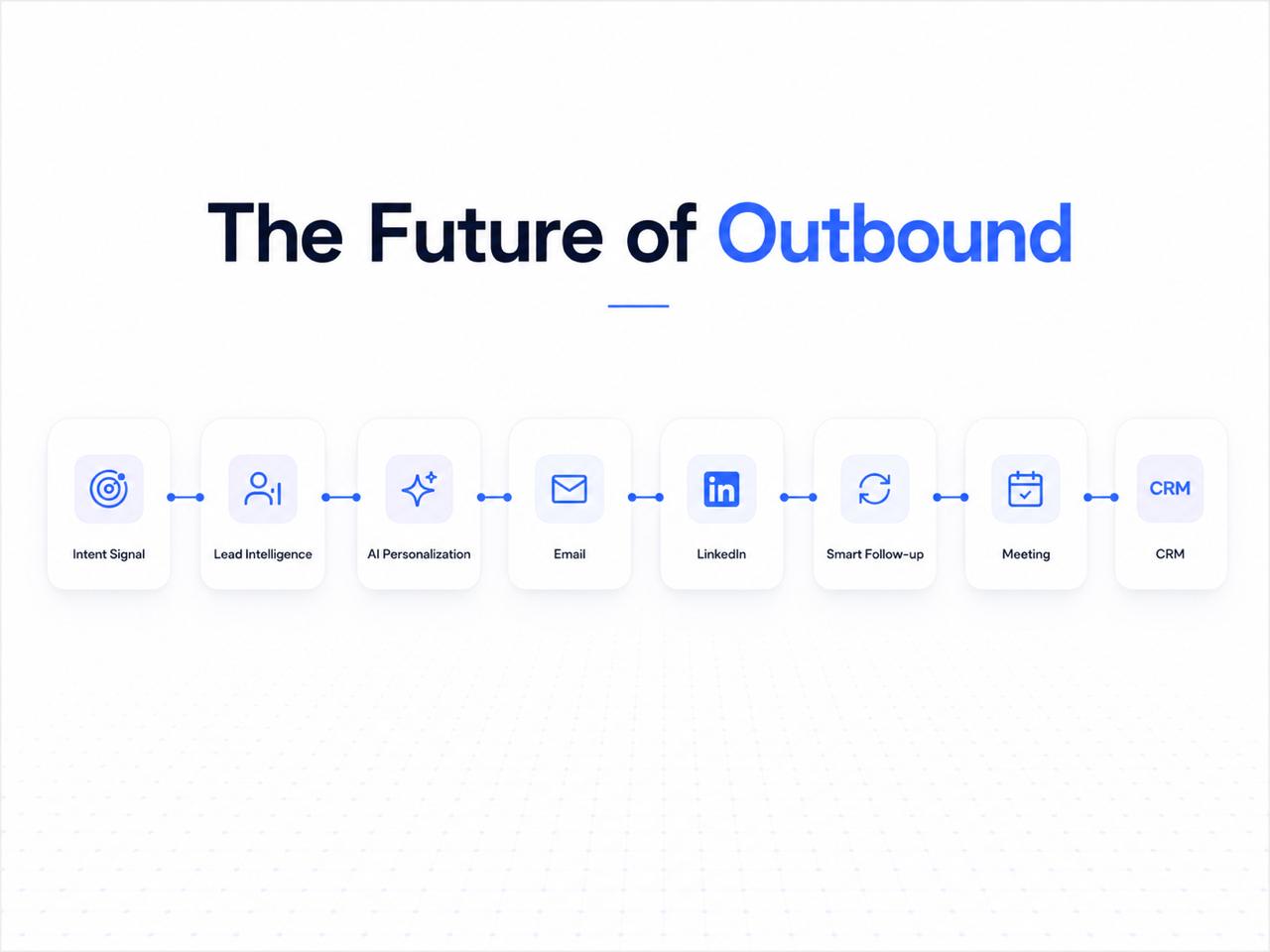
Explore Autoworkx → Book a DemoThe next few years aren't going to bring "cold email is back" or "cold email is finally dead." They're going to bring a quieter shift: cold email becomes one node in a more connected outbound system instead of a standalone channel.
AI agents will move from writing emails to actually managing parts of the sequence: deciding when to follow up, adjusting tone based on reply sentiment, and pulling in research the moment a prospect shows an intent signal, like visiting a pricing page or changing jobs.
Intent signals will get weighted more heavily than static firmographic data. A mid-size company showing active buying signals will get prioritized over a larger company that simply matches the ICP on paper but shows zero behavioral interest.
Personalization will keep moving from surface-level (name, company, title) toward genuinely situational (the specific problem this person is likely dealing with right now, based on real signals, not guesses).
Relationship building will matter more, not less, because as AI-written outreach becomes harder to distinguish from human-written outreach, the differentiator shifts to whether a sender actually follows through like a real relationship is forming, instead of disappearing after the first non-reply.
Multichannel outreach will become the default expectation rather than a competitive edge. Email opens a door. LinkedIn, a follow-up call, or a WhatsApp message keeps the conversation moving when email alone goes quiet. Teams running email in isolation, disconnected from every other channel, will increasingly look like they're missing half the picture.
There's also a likely shift in what counts as a "good list." Right now, most teams still build lists around static firmographic filters: industry, headcount, funding stage. That's already starting to feel outdated. The next version of list building leans on layered signals that update in real time: a company posting a relevant job opening this week, a leadership change that creates a new buying window, a competitor's customer publicly complaining about something your product solves. Static lists answer "who could theoretically buy." Signal-based lists answer "who's actually in a buying window right now," and that distinction will separate average campaigns from great ones going forward.
Deliverability infrastructure will keep tightening too. Mailbox providers have every incentive to keep raising the bar against bulk, low-quality sending, which means the senders who treat domain health and inbox reputation as a long-term asset, rather than something to worry about only after a campaign tanks, will have a growing structural advantage over everyone who treats it as an afterthought.
None of this is a prediction that cold email disappears into some other channel. It's a prediction that cold email stops being judged as a standalone tactic and starts being judged as part of a coordinated system. The companies that build that system early have a real head start.
Conclusion
Cold email isn't dying.
Generic outreach is.
Every founder who declares the channel dead after a failed campaign is really describing the death of a specific approach: no research, no targeting, no warmup, no follow-up discipline, the same template everyone else is sending. That approach was never going to work, in 2020, in 2026, or at any point in between.
The companies still booking meetings from cold email right now aren't lucky. They're doing the unglamorous parts most people skip: building a tight ICP, warming domains properly, writing first lines that prove they actually looked at the recipient, following up more than once, and measuring replies instead of opens.
That's not a secret. It's just work most people don't want to do.
The companies that understand the difference between "the channel is dead" and "my approach was dead" will keep booking meetings while everyone else writes LinkedIn posts blaming cold email for their own shortcuts.
FAQ
Is cold email still effective in 2026?
Yes, for senders who target a specific ICP, personalize based on real signals, and maintain proper domain health. Reply rates have dropped industry-wide for generic outreach, but well-targeted, well-researched campaigns still perform strongly.
What is a good cold email reply rate?
It varies heavily by industry and list quality, but a well-run B2B campaign with a tight ICP and genuine personalization typically lands somewhere between 8 and 20 percent. Anything close to zero usually points to a targeting, offer, or deliverability problem rather than a copy problem.
Why are my cold emails going to spam?
Usually one or more of these: a new domain with no warmup period, sending volume that's too high too fast, spammy link or formatting patterns, or low engagement (opens, replies) signaling to mail servers that recipients don't want the content.
How long should a cold email be?
Generally under 100 words for the first message. Long emails ask for more attention than a stranger is willing to give before trust has been established.
Does AI personalization actually work?
It works when it's used to surface genuine, specific details about a prospect's situation. It fails when it's used to generate more volume of the same generic message faster. The technology amplifies whatever strategy is already underneath it.
How many follow-ups should a cold email sequence have?
Most data points toward four to six touches performing significantly better than one or two. A large share of replies come from later follow-ups, not the first email.
What's the difference between cold email and spam?
Legally and practically, relevance and compliance. A cold email sent to a genuinely fitting prospect, with an easy opt-out and accurate sender information, is outreach. The same email blasted to an unfiltered, irrelevant list at high volume functions as spam, regardless of intent.
Should I warm up a new email domain before sending cold email?
Yes, almost always. A new domain typically needs two to three weeks of gradual, low-volume sending with decent engagement before it can handle full cold email volume without getting flagged.
Is multichannel outreach better than email alone?
For most B2B sales motions, yes. Email opens the conversation efficiently, but combining it with LinkedIn or other touchpoints tends to improve response and meeting rates compared to email in isolation.
How is AI changing outbound sales going forward?
AI is shifting from a writing tool to an operational layer: handling research, follow-up timing, reply classification, and lead prioritization. The senders who use it to genuinely improve relevance are pulling ahead of those using it purely to increase volume.
Ready to Build a Better Outbound System?
Stop relying on generic templates and manual follow-ups. Autoworkx helps founders and sales teams personalize outreach, automate follow-ups, improve deliverability, and book more meetings— all from one platform.