The first few cold emails always look good.
You open the company’s website. Skim the homepage. Check LinkedIn. Write a decent first line. Maybe even tweak the pitch a bit because this one prospect actually looks interesting.
That part is easy.
The problem starts when the list stops being 20 companies and turns into 200.
Now reps are moving fast. Research is happening in random tabs. Notes are sitting in half-filled sheets. One person writes a good first line, another person rewrites it badly, and by the time you get to lead #140, “personalization” has somehow become:
{{first_name}}{{company_name}}“Loved what you’re building”
one vague compliment about the website
the exact same pitch everyone else got
This is where most outbound teams quietly break.
Not because personalization stops working.
Because the process behind it does.
A lot of teams hit the same wall:
they know personalized cold emails get better replies
they don’t have time to research and write 500 one-off emails
they try to scale with AI or templates
quality drops fast
the emails start sounding robotic
then someone decides cold email “doesn’t work anymore”
Usually the real problem is simpler than that. The team never built a proper system for cold email personalization at scale in the first place.
They tried to brute-force something that needed structure.
This article is about how to fix that.
Not with fluffy “just personalize more” advice. And not with fake AI tricks that turn every opener into “impressed by your innovative approach.”
We’re going to break down how smart B2B teams actually do this: how to send hundreds of personalized cold emails without manually writing each one from scratch, where AI helps, where it makes things worse, what data is actually useful, and how to keep outreach feeling relevant even when volume goes up.
Trying to scale personalized cold outreach without turning it into template spam? AutoWorkx helps teams research leads, generate relevant email angles, and automate follow-ups without losing the human feel.
In This Guide
What cold email personalization at scale actually means
Why most “personalized” cold emails still feel robotic
The 5 layers of personalization that actually matter
A practical workflow for personalizing 500 cold emails without writing 500 from scratch
What data to use for personalization, and what to ignore
Real cold email personalization examples: bad vs better
Where AI helps, and where it quietly ruins outreach
Common mistakes teams make when scaling personalized cold email
How AutoWorkx fits into the workflow
What Cold Email Personalization at Scale Actually Means
A lot of bad cold email advice starts with a bad definition of personalization.
So let’s fix that first.
Cold email personalization at scale does not mean writing 500 completely custom emails by hand.
It also doesn’t mean taking a generic sequence and sprinkling in a few variables like:
{{first_name}}{{company_name}}“Saw your recent post”
“Loved your website”
That’s not personalization. That’s just making a template look busy.
Real personalized cold emails at scale work differently.
The goal is to build a system where:
useful prospect and company context is pulled automatically
the right signals are structured instead of scattered across tabs and notes
messaging changes based on relevant context, not random details
the offer stays stable enough to learn from results
the email still feels like it was written with intent
That last part matters.
Because the real job of personalization isn’t to prove you researched someone. It’s to make the email feel relevant enough to keep reading.
That’s the standard.
Not “did we mention their company name?”
Not “did AI generate a first line?”
Not “did the sequence tool fill in all the variables?”
If the message doesn’t feel relevant to the person receiving it, it’s not personalized in any way that matters.
So when we talk about scalable cold email outreach, this is the working definition:
Personalization at scale is a system for producing relevant outreach consistently, without needing to hand-write every email from zero.
That system usually includes:
a narrow ICP
structured prospect research
reusable personalization blocks
role-based messaging
trigger-based context
stable offer/CTA logic
a review loop before and after launch
That’s the difference between “we personalized 500 emails” and “we blasted 500 templates with different names on top.”
Why Most “Personalized” Cold Emails Still Feel Robotic
A cold email can contain personalized details and still feel completely generic.
That’s what trips people up.
The problem usually isn’t that the email has no personalization. It’s that the personalization is shallow, irrelevant, or disconnected from the actual pitch.
This is also why so many teams end up thinking cold email itself is broken, when the real issue is the quality of the targeting, messaging, and system behind it. We broke that down in Why Cold Email Isn’t Dead in 2026 (You’re Just Doing It Wrong).
Here’s what that looks like in practice.
1) Merge fields pretending to be personalization
You’ve seen this one:
“Hi Sarah, I wanted to reach out because at Acme you seem to be doing great work in the SaaS space.”
Nothing about that line earns attention.
It doesn’t show understanding. It doesn’t point to a problem. It doesn’t tell the prospect why this email is for them instead of the other 600 people in the sequence.
It just proves your tool can insert a name.
2) Generic AI compliments
This is probably the most common failure mode right now.
“I came across your website and was impressed by your innovative solutions and customer-centric approach.”
Nobody believes this. And honestly, they shouldn’t.
It’s the kind of line that sounds polished for half a second, then immediately reads like machine-generated filler.
The issue isn’t that AI wrote it. The issue is that it says absolutely nothing.
3) Random facts with no connection to the offer
A rep finds one detail and assumes the email is now personalized.
“Saw you recently hired a Head of People, congrats.”
Fine. But why is that relevant to the email? What does it change? Why are you bringing it up?
If the observation doesn’t connect to a likely pain, opportunity, or reason for outreach, it’s just trivia wearing a personalization costume.
4) LinkedIn bio rewrites passed off as research
Example:
“Noticed you’re passionate about helping teams unlock growth and create amazing customer experiences.”
That’s usually just a cleaned-up version of their LinkedIn headline.
It’s not insight. It’s not context. It doesn’t help the message land.
5) A personalized first line sitting on top of a generic email body
This one happens constantly.
The first line sounds specific. Then the body drops into a totally generic pitch that could have been sent to anyone.
That disconnect kills trust fast.
A lot of teams think they’re testing personalization when they’re actually doing this:
changing the opener
changing the segment
changing the offer
changing the CTA
changing the tone
Then the campaign underperforms and nobody knows what actually failed.
So yes, the first line matters. But if the rest of the email ignores the context you opened with, the prospect feels the mismatch immediately.
Good personalization doesn’t stop at the first sentence. It should influence the angle, the problem framing, and sometimes even the proof you use.
The 5 Layers of Cold Email Personalization
Most teams treat personalization like one single thing. It’s not.
There are layers to it, and some layers matter much more than others.
If you want personalized cold emails at scale that still feel human, this is the framework worth thinking in.
Layer 1: ICP-Level Relevance
This is the base layer. If this part is weak, the rest doesn’t matter much.
Before you personalize for a person, you need the message to make sense for the type of company and type of buyer you’re targeting.
For example, if you sell outbound software, your messaging should change depending on whether you’re targeting:
founder-led SaaS companies
SDR-heavy sales teams
outbound agencies
RevOps leaders
growth teams in PLG companies
Even if two prospects are both in SaaS, they may not care about the same thing at all.
A founder at a 15-person startup might care about getting pipeline without hiring three SDRs.
A Head of Sales at a 200-person company probably cares more about rep productivity, sequence performance, and consistency across campaigns.
Same category. Different angle.
If the ICP-level relevance is off, no amount of “noticed your recent post” is going to save the email.
Layer 2: Company-Level Personalization
This is where the message starts feeling specific to the business itself.
You’re looking for company context that changes the conversation in a meaningful way.
Useful signals here include:
homepage positioning
product messaging
pricing model
case studies
target segment
hiring patterns
funding or expansion moves
whether the company is founder-led, sales-led, or product-led
The point isn’t to collect interesting facts. The point is to spot something that changes how you frame the problem.
Example
Weak version:
“Loved what your team is building at X.”
Better version:
“Looks like you’re moving upmarket based on the homepage copy and recent case studies. That’s usually where outbound gets harder because the list gets smaller and generic outreach gets expensive fast.”
That’s a company observation connected to a likely sales problem.
Layer 3: Role-Level Personalization
Different people inside the same company care about different outcomes.
This sounds obvious, but teams still send the same email to founders, SDR leaders, marketers, and RevOps people and wonder why reply rates are inconsistent.
A founder might care about:
doing more with a lean team
speeding up pipeline creation
not hiring more outbound headcount too early
A Head of Sales might care about:
rep output
reply rates
pipeline quality
how fast the team can scale without quality dropping
RevOps probably cares about:
process consistency
data quality
workflow sprawl
tool chaos
Same company. Same product. Different buying logic.
If the email ignores that, it feels lazy even if the first line is personalized.
Layer 4: Trigger-Based Personalization
This is where timing enters the picture.
A trigger is a signal that something changed in the company, and that change makes your email more relevant right now.
Examples:
hiring SDRs or AEs
raising funding
moving upmarket
launching a new product
expanding into a new segment
changing positioning
posting actively about pipeline, outbound, or growth
Good trigger-based personalization gives the email a reason to exist today.
Example
“Saw you’re hiring SDRs while pushing into mid-market accounts. That’s usually the point where outbound volume needs to go up, but manual personalization starts breaking before the new reps are even fully ramped.”
That’s much stronger than “congrats on the growth.”
Layer 5: Pain-Point Personalization
This is the most important layer, and it’s the one most teams skip.
The job of personalization is not to mention a fact.
It’s to connect a fact to a likely problem worth solving.
That’s the difference between “we researched them” and “this email is actually relevant.”
Weak personalization
“Noticed you’ve been posting a lot on LinkedIn recently.”
Better pain-point personalization
“Saw you’re posting pretty actively around pipeline and outbound. Usually when founders are that close to the GTM motion, it means they care a lot about messaging quality — but the actual outreach system still hasn’t caught up, so reps end up sending generic emails with a personalized first line on top.”
That’s a much more useful place to start a cold email from.
Which Type of Personalization Actually Scales?
Not all personalization is worth scaling.
Some of it is just cosmetic. Some of it actually changes the quality of the conversation.
Here’s the difference.
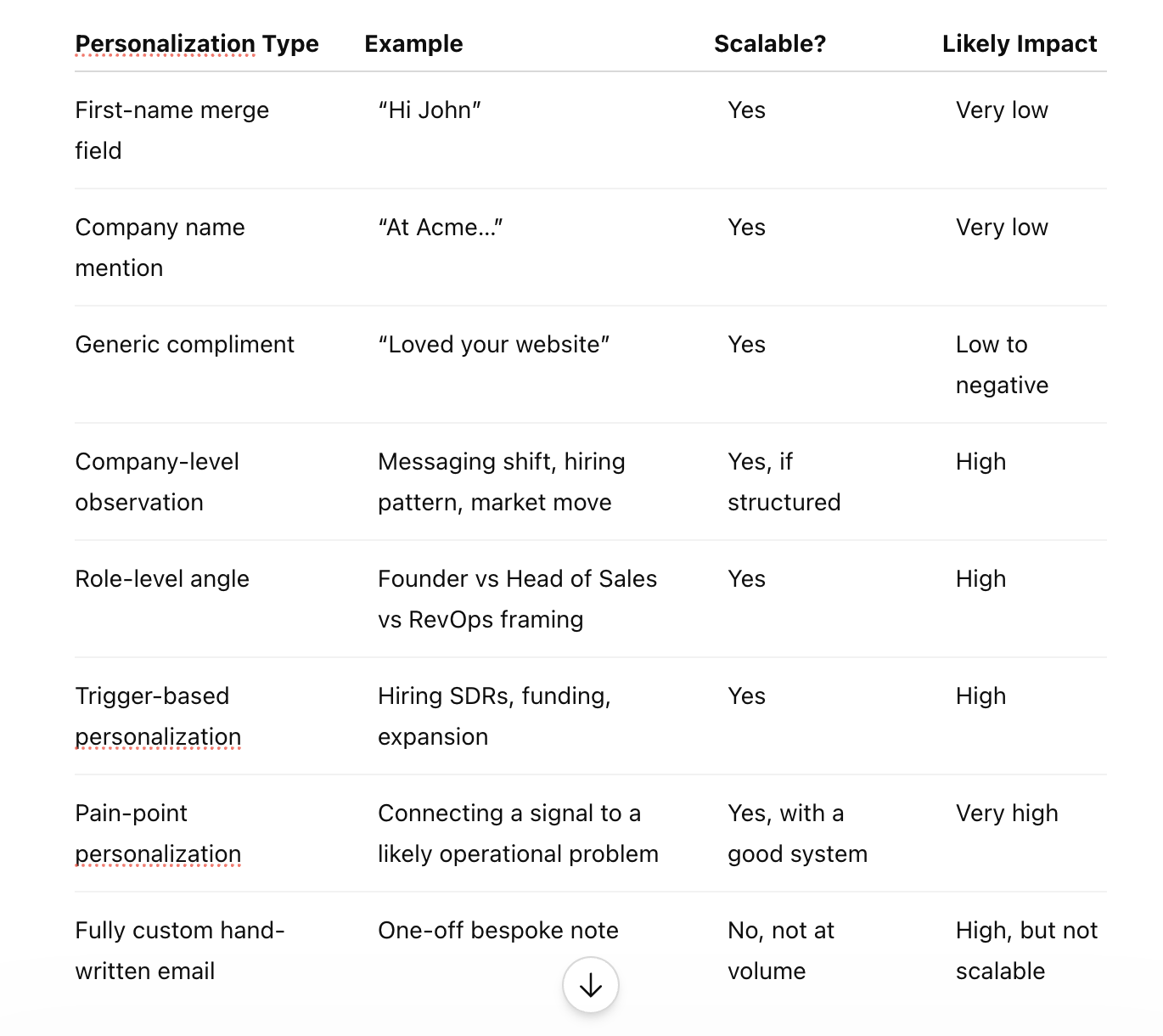
If you’re trying to improve cold email personalization at scale, this table is the whole game.
Scale the things that change relevance.
Stop obsessing over the things that only make the email look personalized.
How to Personalize 500 Cold Emails Without Writing 500 From Scratch
This is the part most blog posts glide over.
They’ll say “use AI” or “segment your list” and move on. But the workflow is the real thing people need.
So here’s a practical system for how to send personalized cold emails at scale without turning the team into full-time researchers.
Step 1: Start with one narrow ICP
If your list includes SaaS founders, agencies, ecommerce brands, consultants, recruiters, and healthcare startups, you do not have a personalization problem.
You have a targeting problem.
Pick one narrow segment first.
Examples:
founder-led B2B SaaS companies with 10–50 employees
sales-led SaaS teams hiring SDRs
outbound agencies serving B2B clients
companies moving from SMB into mid-market
The narrower the ICP, the easier it is to build reusable personalization logic that doesn’t sound fake.
This is also where most campaigns quietly go wrong. Teams want volume, so they widen the list too early. Then they wonder why every email needs a different angle and nothing scales properly.
Step 2: Group leads by meaningful similarity
You do not want 500 unrelated companies in one campaign.
You want clusters.
For example:
companies hiring SDRs
companies with weak or generic homepage messaging
founder-led teams posting actively about outbound
companies moving upmarket
agencies running outbound for clients
recently funded teams building GTM from scratch
These clusters are what let you write reusable personalization blocks that still feel relevant.
Without them, the team ends up trying to personalize lead by lead forever, which is exactly the bottleneck you’re trying to escape.
Step 3: Capture structured signals, not random notes
This is one of those things that sounds boring until you’ve seen a team try to scale without it.
Once reps start researching in random tabs, dropping notes into half-finished sheets, and interpreting every lead differently, the whole process falls apart after the first decent-sized list.
For each lead, you want a small set of structured inputs like:
company name
ICP / company category
role of contact
one trigger or recent change
one likely pain angle
one relevant company-level observation
one personalization block category
That’s enough to write something relevant without drowning the team in research.
This is also the layer where a tool like AutoWorkx becomes useful. If the system can pull company-site data, summarize context, and organize signals into usable personalization inputs, you remove a huge amount of manual work before the writing even starts.
Step 4: Build personalization blocks, not one-off intros
This is where scalable personalization actually happens.
A personalization block is a reusable opener or angle tied to a pattern you keep seeing across similar leads.
Instead of writing 80 completely different intros for 80 companies hiring SDRs, you create 3–5 strong variations for that scenario.
Example: hiring SDRs
“Saw you’re hiring SDRs. Usually that’s the point where outbound volume starts growing faster than the team’s ability to keep the messaging sharp, especially if reps are still researching and writing first lines manually.”
Example: moving upmarket
“Looks like the positioning is shifting toward mid-market based on the homepage and recent case studies. That transition usually makes generic outbound more expensive because the list gets smaller and every email has to work harder.”
Example: agency doing outbound for clients
“Looks like you’re running outbound across multiple client accounts. That usually means the bottleneck isn’t sending more campaigns — it’s keeping research and personalization quality consistent across very different offers.”
That’s the level you want to operate at.
Not “custom email for every single lead.”
Not “one generic template for everyone.”
A middle layer built around patterns.
Step 5: Use AI to draft variations, not to invent the strategy
AI is useful. But only if you use it at the right point in the workflow.
Bad use of AI:
“Write 500 personalized cold emails for this CSV”
no segmentation logic
no structured inputs
no clear pain angle
no QA
no stable offer
That’s how you get 500 polished-sounding bad emails.
Better use of AI:
summarize website and company context
classify leads into clusters
turn raw research into draft personalization blocks
adapt tone for founder vs Head of Sales vs RevOps
generate 3–5 opener variations once the angle is already good
help with follow-ups after the core email is set
The key point: AI should speed up a system you already designed. It shouldn’t be asked to create the system for you.
This is the gap AutoWorkx is designed to close: using AI to support structured personalization workflows, not to mass-produce generic intros from a CSV.
Step 6: Keep the offer and CTA stable
A lot of teams think they’re testing personalization when they’re actually changing everything at once.
They personalize the opener, change the offer, tweak the CTA, switch the tone, and target a different segment in the same campaign. Then nothing works and nobody knows why.
A better setup looks like this:
Variable: opener / context / pain framing
Mostly stable: offer, value proposition, CTA
Lightly adaptable: proof or one supporting sentence by segment
That gives you room to personalize without turning the campaign into chaos.
Step 7: Review the first batch manually before sending at volume
Do not trust automation just because the emails look smooth.
Review the first 20–30 emails and ask:
does this sound like something a smart human would actually send?
is the observation relevant or just technically personalized?
is the body aligned with the opener?
did AI invent anything weird?
would this still make sense if I received it cold?
You catch most of the embarrassing mistakes here:
fake compliments
irrelevant triggers
intros that feel specific but bodies that feel mass-sent
over-polished AI phrasing
hallucinated details
Step 8: Watch reply quality, not just send volume
The easiest way to fool yourself in outbound is to look at activity metrics and assume the campaign is fine.
The better signal is replies.
Look at:
positive replies
neutral curiosity replies
confused replies
“not relevant” replies
spam complaints
prospects calling out generic outreach
That’s where you’ll find out whether the personalization is actually landing.
A Simple Personalization Workflow for a 500-Lead Campaign
If you want a practical version of all of this, here’s the simplest framework I’d use for a 500-lead outbound campaign.
For each lead, capture just 5 things:
Company / ICP category
Example: founder-led SaaS, outbound agency, mid-market sales teamOne relevant trigger
Example: hiring SDRs, recent funding, moving upmarket, founder posting about pipelineOne likely pain
Example: manual personalization doesn’t scale, messaging isn’t translating into outbound, reps are spending too much time researchingOne role-specific angle
Example: founder cares about leverage, Head of Sales cares about reply rates and rep productivityOne stable CTA
Example: worth showing how teams are automating personalization without making the emails feel templated?
That gives you enough to build the actual email:
Intro line
Use the trigger + company context.
Pain framing
Connect the trigger to a likely problem.
Body
Tie that problem to your offer with one clear value proposition.
CTA
Keep it simple and stable.
That’s it.
Not 25 data points. Not a giant research dossier. Just enough structure to make the email relevant without slowing the campaign to a crawl.
AutoWorkx helps teams pull company context, organize personalization signals, and generate outreach + follow-ups around a real workflow — not just a generic prompt.
What Data Should You Actually Use for Cold Email Personalization?
This is where teams lose a lot of time.
Not every data point deserves a place in the email. And not every signal is useful just because you can scrape it.
The better question is:
What information actually changes the message?
High-value personalization signals
These are usually worth paying attention to.
1) Homepage positioning
This tells you:
who they sell to
how clearly they describe the product
whether they’re moving upmarket
whether their GTM story is sharp or generic
2) Product and solution pages
Useful for understanding:
the use case they care about most
the buyer persona
the complexity of the product
how mature the sales motion probably is
3) Job posts
Underrated signal.
Job descriptions can tell you whether they’re:
building outbound
investing in RevOps
hiring SDRs
trying to improve pipeline generation or sales process
4) Funding or expansion signals
Useful when they clearly connect to GTM change:
new funding round
new market expansion
headcount growth
enterprise push
sales team buildout
5) Case studies and customer stories
These help you see:
who they really want more of
how mature their positioning is
what outcomes they sell around
6) Founder / leadership content
Especially useful in founder-led SaaS.
You can often spot:
what they’re focused on right now
what’s frustrating them
how they talk about growth
whether outbound is already on their mind
7) Pricing page and packaging
This often reveals:
self-serve vs sales-led motion
SMB vs mid-market vs enterprise focus
product maturity
monetization logic
Low-value personalization signals
These are the ones people overuse because they sound personal but rarely make the email better.
“Loved your website”
Usually fake. Almost always useless.
“Congrats on your recent success”
Too vague to matter.
Random personal trivia
A marathon photo, coffee post, college mention, unless it genuinely connects to your reason for reaching out, it probably doesn’t belong in the email.
Job title + company name only
Good for routing. Not enough for relevance.
Any detail that doesn’t change the message
This is the easiest filter to use.
If the detail doesn’t change the problem framing, the angle, or the reason for the email, leave it out.
Cold Email Personalization Examples: Bad vs Better
The easiest way to explain good personalization is to show the difference between a line that sounds “personalized” and a line that actually feels relevant.
Example 1: Hiring SDRs
Bad
Hey Jake, saw you’re hiring SDRs at Northbeam and loved what you’re building.
Better
Saw you’re hiring SDRs. Usually that’s the point where outbound volume starts climbing, but personalization quality drops because reps are still doing too much of the research manually.
Why it’s better
It’s shorter, more believable, and it actually points to a likely problem.
Example 2: Moving upmarket
Bad
Congrats on the growth at Acme. Looks like exciting things are happening.
Better
Looks like you’re moving upmarket based on the recent case studies and pricing language. That shift usually makes generic outbound more expensive fast.
Why it’s better
It doesn’t waste time with filler. It connects the observation to a real sales consequence.
Example 3: Weak messaging on the site
Bad
I checked your site and really liked your innovative messaging around customer engagement.
Better
Went through the homepage and a couple of solution pages, feels like the product is clear, but the outbound angle still isn’t. That’s usually where reps end up defaulting to generic first lines.
Why it’s better
It sounds like an actual observation, not a compliment generator.
Example 4: Founder posting about pipeline
Bad
Loved your recent LinkedIn post on growth. Really insightful.
Better
Saw you’ve been posting a lot around pipeline recently. Usually when founders are that close to the GTM motion, it’s because messaging quality actually matters, but the outreach process still hasn’t caught up.
Why it’s better
It uses the content signal as context, not as flattery.
Example 5: Agency running outbound for clients
Bad
Came across your agency and thought this might be relevant.
Better
Looks like you’re running outbound for multiple client accounts. That usually means the real bottleneck isn’t sending more emails, it’s keeping research and personalization quality consistent across very different campaigns.
Why it’s better
It speaks directly to the operational pain of that business model.
Where AI Helps, and Where It Makes Personalization Worse
AI cold email personalization is one of those areas where both the hype and the backlash are partly right.
Yes, AI can help you personalize cold emails at scale.
It can also turn your campaign into polished spam if you use it lazily.
The difference is where it sits in the workflow.
Where AI actually helps
1) Summarizing research
AI is genuinely useful for turning messy website, LinkedIn, and company data into something usable.
That saves a lot of time.
2) Grouping leads into clusters
If your signals are structured, AI can help classify leads into categories like:
hiring SDRs
moving upmarket
founder-led GTM
weak outbound messaging
agency model
recent funding
That makes scalable personalization much easier.
3) Drafting opener variations
Once you already have a strong angle, AI can help generate a few versions of the opener without making the rep rewrite everything manually.
4) Adapting tone by role
Founder email vs Head of Sales email vs RevOps email, same core idea, slightly different framing.
AI can help there.
5) Helping with follow-ups
Once the core message is set, AI can help build follow-ups that don’t feel like copy-pasted reminders.
This is also where a system like AutoWorkx becomes useful in a very practical way. If the platform is already pulling company context, organizing signals, and helping turn that into personalization blocks + follow-ups, you’re not just saving writing time, you’re fixing the workflow bottleneck behind the writing.
Where AI makes things worse
1) Fake compliments
This is the obvious one.
AI loves writing lines like:
“I was impressed by your innovative platform”
“Loved your customer-centric approach”
“You’re doing incredible work in the space”
These lines sound polished and empty at the same time.
2) Hallucinated context
If the underlying inputs are messy, AI can invent details confidently enough that the email still looks clean.
That’s a problem.
3) The same “human-sounding” voice for everyone
Sometimes AI makes every email sound smooth in exactly the same way. That’s not personalization. That’s one tone wearing 500 different names.
4) Speed without strategy
If the ICP is too broad, the signals are weak, and the offer is unclear, AI doesn’t fix anything. It just helps you send a broken message faster.
That’s why the useful way to think about AI is simple:
AI should reduce manual work inside a good outbound system. It should not be the outbound system.
Common Mistakes Teams Make When Personalizing Cold Emails at Scale
If a campaign is “personalized” and still not getting replies, one of these is usually going on.
1) The ICP is too broad
The wider the segment, the harder it is to keep the message relevant.
2) The team is changing too many things at once
The opener changes, the offer changes, the CTA changes, the segment changes, then nobody knows what actually caused the result.
3) They’re personalizing details instead of problems
Mentioning a fact is not the same as making the email relevant.
4) Multiple segments are being forced into one sequence
Different segments usually need different pain framing. One bloated “master sequence” tends to underperform.
5) The first line is personalized, but the body is generic
Prospects notice this immediately.
6) The offer changes too often
If every email pitches something slightly different, there’s nothing to learn from the campaign.
7) Deliverability is being ignored
A well-personalized email still needs to land in the inbox.
8) Nobody is reviewing reply quality
Open rates are easy to stare at. Replies tell you whether the message actually made sense.
Before You Launch a Personalized Cold Email Campaign: Quick Checklist
Before sending the first batch, run through this:
Campaign QA Checklist
Is the ICP narrow enough that one message angle genuinely makes sense?
Have you grouped leads into meaningful clusters instead of one giant mixed list?
Is each personalization input tied to a likely pain, trigger, or business change?
Are you using company-level and role-level context instead of just merge fields?
Does the body of the email actually match the personalized opener?
Is the offer stable enough to learn from results?
Have you manually reviewed a sample of emails before launching volume?
Is deliverability healthy?
Do you have a plan to review replies and refine the campaign?
If the answer to most of these is no, the problem probably isn’t “we need more personalization.”
It’s that the system behind the campaign still isn’t solid.
How AutoWorkx Fits Into This Workflow
The hard part of cold email personalization at scale isn’t writing one clever opener.
It’s everything around it.
It’s:
pulling useful company data
figuring out which signals actually matter
grouping leads by pattern
turning research into usable personalization blocks
drafting outreach and follow-ups without losing relevance
doing all of that without making reps spend half their day in random tabs
That’s the problem AutoWorkx is built around.
Not “write me a cute first line.”
The actual operational mess behind scaled personalization.
AutoWorkx helps teams move from:
“we know personalization matters”
to:
“we actually have a system for doing it consistently.”
That includes the parts most teams struggle with:
extracting context from company websites and public signals
structuring those signals so the team can actually use them
turning research into personalization blocks instead of random notes
generating outreach and follow-ups that stay tied to the context
reducing manual work without dropping into generic automation
This matters most for teams stuck in the awkward middle:
too much volume to personalize every email manually
too much competition to send generic sequences
too small a team to build a heavy outbound machine from scratch
That’s where the workflow starts breaking. And that’s usually the moment teams either give up on personalization or start over-automating it.
AutoWorkx is meant to solve that middle layer.
If you want to expand on the broader automation side of this, this is a natural place to link to AI Email Marketing Automation: The Complete Guide for 2026.
Conclusion: Personalization at Scale Is Mostly a Workflow Problem
If there’s one thing worth taking from this whole guide, it’s this:
You do not need 500 fully custom emails.
You need a better system for relevance.
The teams that do cold email personalization at scale well are usually not the teams writing every message from scratch. They’re the teams that figured out how to combine:
a narrow ICP
useful signals
strong pain-angle logic
reusable personalization blocks
AI in the right places
stable offers
feedback loops based on replies
That’s what makes it possible to send hundreds of personalized cold emails without sounding robotic.
So if your current outreach feels stuck between two bad options, manual and slow, or automated and soulless that’s the wrong tradeoff.
There’s a better middle ground.
Build the workflow. Structure the context. Personalize the parts that actually change the message.
That’s how you scale cold email without killing the part that makes it work.
FAQ: Cold Email Personalization at Scale
What is cold email personalization at scale?
Cold email personalization at scale is the process of sending large volumes of outreach while still making each email feel relevant to the recipient. It doesn’t mean writing every email manually. It means using structured research, segmentation, and reusable personalization logic so the message still feels specific.
How much personalization is enough in a cold email?
Usually less than people think. One strong company-level or trigger-based observation tied to a real pain point is often enough. The goal isn’t to prove you researched them. It’s to make the email feel relevant.
Can AI personalize cold emails effectively?
Yes, if it’s used in the right part of the workflow. AI is useful for research summarization, clustering leads, drafting opener variations, and helping with follow-ups. It’s much less useful when you ask it to blindly generate “personalized” outreach with no structure behind it.
How do I personalize cold emails in bulk without sounding robotic?
Start with a narrow ICP, group similar leads together, capture structured signals, build reusable personalization blocks, keep the offer stable, and manually review samples before sending at volume.
Is first-line personalization enough?
No, not usually. A personalized opener helps, but if the rest of the email is generic, the message still feels mass-sent. Good personalization should influence the angle and problem framing, not just the first line.
What are the best cold email personalization examples?
The best examples connect a company signal, role context, or trigger event to a likely business problem. Mentioning that a company is hiring SDRs is fine. Explaining why that probably creates an outbound personalization bottleneck is much better.
How many variables should a personalized cold email include?
Usually fewer than most teams use. One or two strong variables tied to a relevant pain point are often enough. Too many variables can make the email feel unstable, over-engineered, or fake.
Is cold email personalization worth the effort?
Yes, if it’s done with a proper system. Better personalization improves reply quality, makes outreach feel more relevant, and reduces the “this was clearly mass-sent” reaction. Shallow personalization usually isn’t worth much.
What data is best for personalized cold emails?
Homepage positioning, product pages, hiring activity, funding, case studies, founder content, pricing pages, and recent GTM changes are usually the strongest signals. Generic compliments and random trivia usually aren’t.
How do I avoid sounding robotic in personalized outreach?
Use observations that actually change the message. Avoid generic compliments, avoid over-polished AI phrasing, and make sure the body of the email matches the context in the opener.
Ready to 10x Your Email Outreach?
Automate personalized cold emails, smart follow-ups, and campaign execution with AutoWorkx — so your team spends less time managing outreach and more time closing deals.
No credit card required • 14-day free trial • Cancel anytime